Member Highlight: OPCMIA Local 528, Concrete Masons Building the Green Future
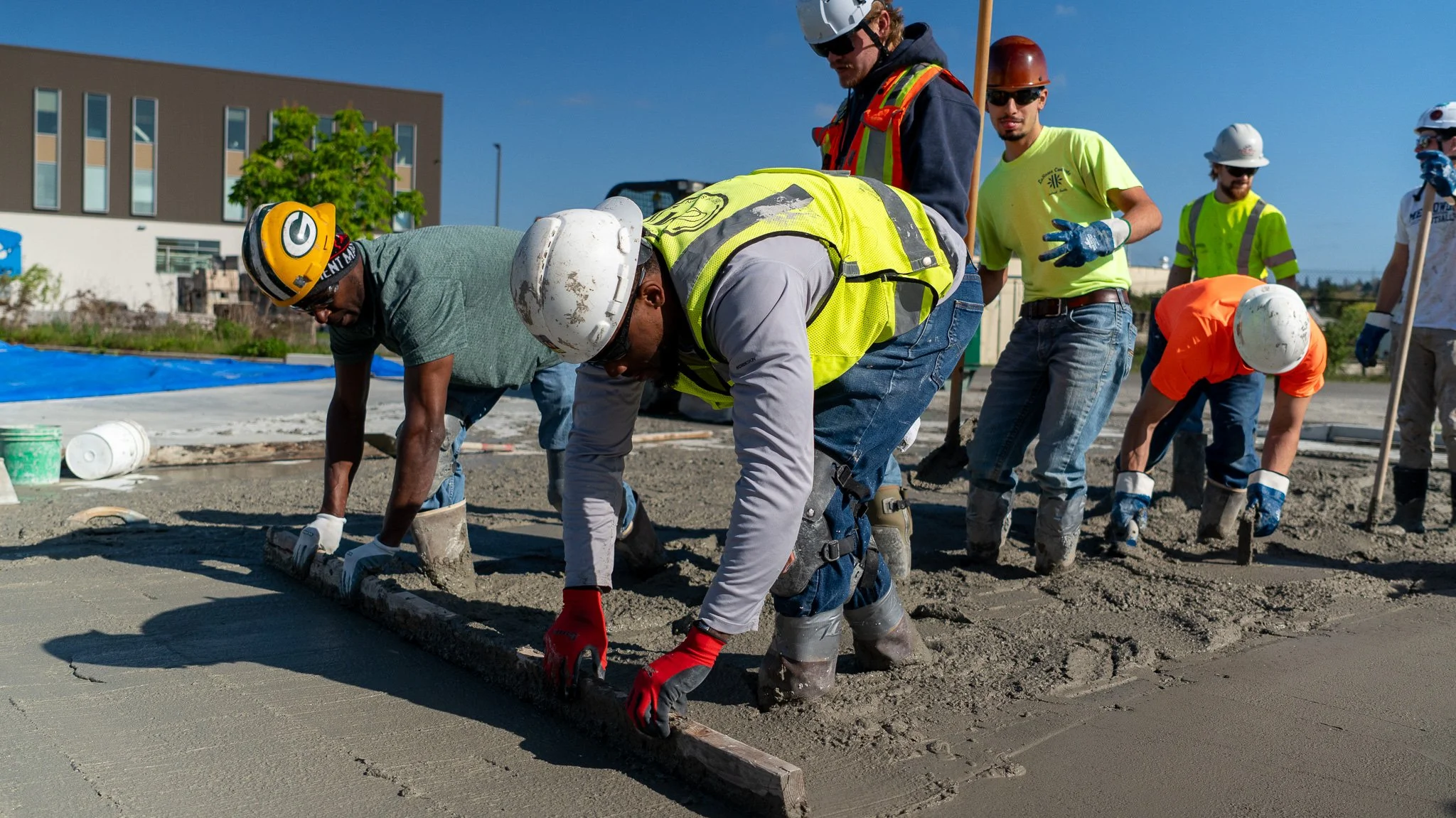
Apprentices learning to rod with instructor.
The ground beneath your feet is changing, literally. The concrete that makes up our sidewalks, roads, and buildings is at the center of one of the biggest environmental and industrial shifts in over a century.
The US cement industry has set a target of net zero by 2045, and the workers of OPCMIA Local 528 are leading it.
Concrete Has a Carbon Problem, and the Industry Knows It
Most people don't think much about concrete. It's just... there. Sidewalks, parking lots, building foundations, overpasses. But here's a number that might surprise you: concrete is the second most consumed material on Earth, right behind water, and the process that binds cement all together is responsible for a significant share of global CO2 emissions.
As Raymond Dumas, Business Agent for Local 528, put it simply, “concrete is a massive part of our world, and that means its carbon footprint is massive too.”
Making cement requires heating Limestone, shale, and clay, in a kiln at extreme temperatures. This chemical process releases large amounts of CO2 gas.
Seattle Is Ground Zero for the Change
While the rest of the country is still warming up to the idea of low-carbon cement, Seattle is already deep in the work. City projects are increasingly being specified with 15 to 20% reductions in Portland cement, using what's called supplemental cementitious materials. These are things like limestone powder, fly ash, or slag from steelmaking, that can partially replace the carbon-heavy ingredient.
And that number is only going to grow.
Part of what's driving Seattle's pace isn't just government policy; It's private sector demand. Amazon, Microsoft, and Google all have major construction projects in the region and carbon reduction targets set for 2030. These are ambitious targets and low-carbon concrete can play a large role in achieving them.
Dave Landrey, a cement materials expert and longtime partner of Local 528, describes the shift clearly:
"Here, it's full steam ahead because Amazon, Microsoft, Google have huge projects, and they're essentially saying, 'Our carbon reduction targets are 2030. You're gonna build our projects, and you're gonna hit this reduction in carbon.'"
The Apprenticeship Program: Training for What's Coming
Local 528's apprenticeship program is at the heart of the union's strategy to stay ahead of these changes. Apprentices complete a four-year program made up of 16 courses, 40 hours per quarter, covering everything from concrete fundamentals to the latest finishing methods and green materials. Veterans stay current through journeyman upgrade classes and industry demonstration events.
Mike Raymond, the Apprenticeship Coordinator for Local 528, describes the core challenge of training workers on these new materials:
"One of the biggest challenges is a lot of times you don't have a history of what this product can do. We're so familiar with tried and true methods with tried and true materials. Now we're gonna implement those same methods into a material we've never necessarily worked before."
Some adjustments are almost counterintuitive, like returning to older, slower finishing techniques using wood and fiber floats instead of faster modern tools. The new materials need to "breathe" during the curing process, and rushing that can cause surface failures. On a job site where schedules are tight and time is money, that kind of change requires both knowledge and buy-in.
One of the biggest upcoming milestones is a Placer Day demonstration event on September 30th, where the apprenticeship will pour a permanent 50x50 concrete slab using low-carbon materials, partnering with industry organizations like ACI and suppliers to document how the material performs over the long term. It's real-world testing that generates real-world data, not a lab experiment, but an honest look at how these materials hold up under actual conditions.
What makes Local 528 especially notable is that their investment in green training didn't come from the top down. The members voted on it. Every dollar spent on initiatives beyond the standard curriculum comes out of member dues, and the membership, particularly the younger generation, voted overwhelmingly to pursue it.
Mike Raymond summed up that energy well:
"Our younger generation voted that this is definitely something we need to pursue. They believe in the earth and the changes we can make. That push from the younger generation is extremely important to them."
That kind of grassroots commitment to the future of the trade is what's setting Local 528 apart.
3D Concrete Printing: Where Craft Meets Technology
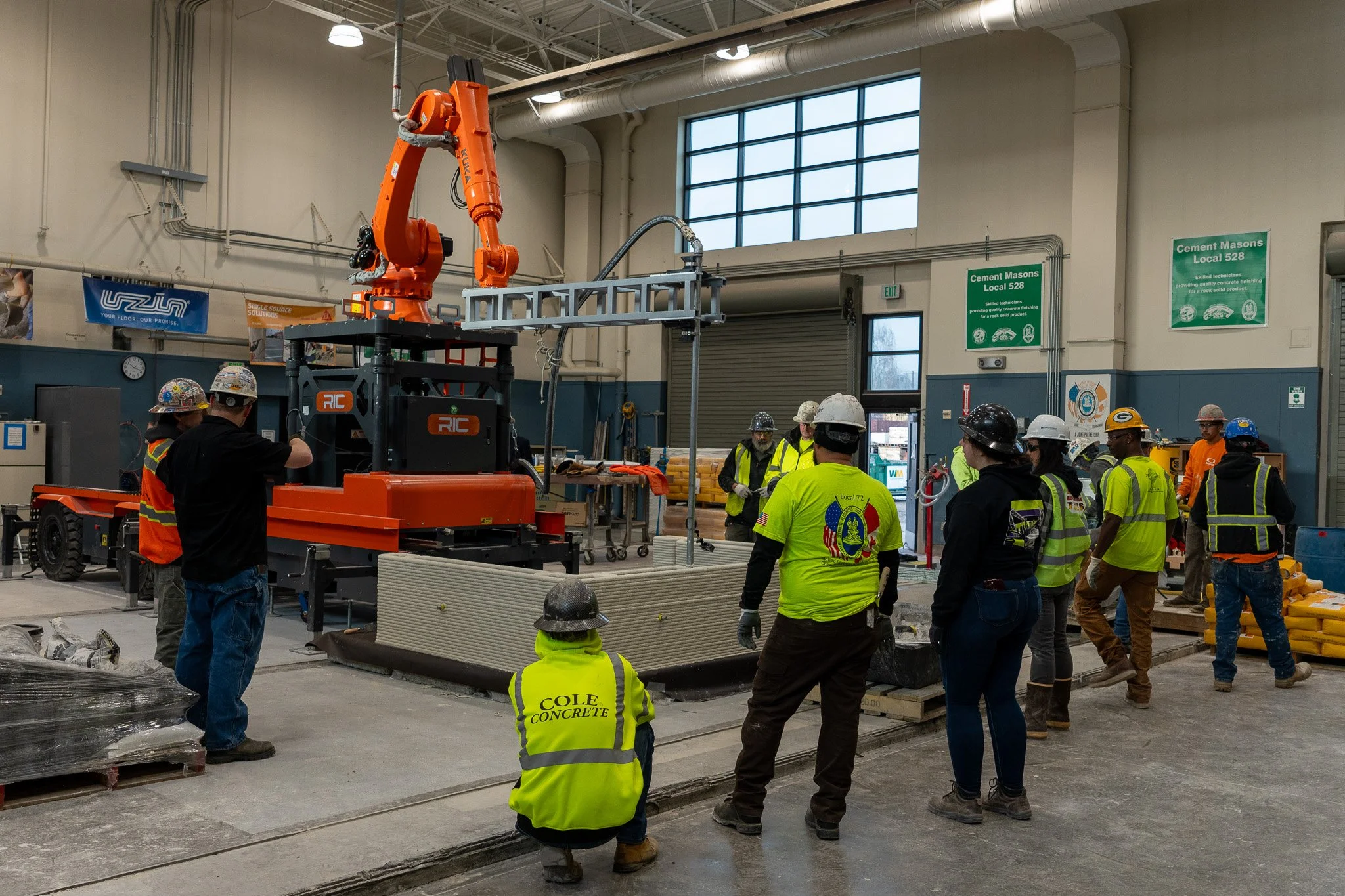
3d concrete printing classes.
If low-carbon cement is the evolution, 3D concrete printing might be the revolution. Local 528 purchased their own 3D concrete printer and it has become one of the most talked-about parts of their training program.
The machine extrudes concrete in layers (Dumas describes it as "layers of soft serve ice cream being built on themselves") to create structures without traditional form boards. That means less one-time-use material, less waste, and dramatically more creative design possibilities: rounded shapes, complex angles, and forms that would be difficult or expensive to build conventionally.
The materials used in 3D printing are largely synthetic and low-carbon, making it doubly green. And Local 528's members aren't just experimenting locally. They're traveling to jobs in California, Alaska, Pennsylvania, and Texas to do this work, with people coming back to the Seattle training center to get certified.
Raymond sees this as part of a bigger vision:
"We hope to be a regional hub for education; a flagship workforce development model on how this works. It's a really creative intersection between traditional hands-on labor and technology."
What's become clear is that the technology side of 3D printing needs the labor side just as much as the other way around. Early efforts led by tech-focused operators ran into problems once they hit real job sites, issues with layout, material behavior, and on-the-fly adjustments. Skilled cement masons stepped in and filled those gaps.
The Science of Scaling: What Will Actually Work
Not every green cement idea is ready for the real world, and Dave Landrey has made it his mission to separate what's promising from what's still a university experiment.
The US consumes roughly 500 million tons of cement per year. Any solution that can't be produced at meaningful scale, at least 100 million tons, isn't going to make a dent in the emissions problem, no matter how exciting it looks in a lab. Landrey focuses only on cements that are market-ready, have existing supply chains, and can realistically compete with traditional Portland cement on cost.
On the cost question, there's an important nuance worth understanding. Green concrete gets labeled as "more expensive," and in pilot projects it can be, but that's largely because it's being produced in small, one-off batches. As production scales up and as suppliers build local plants those costs will come down substantially. Landrey is working on exactly that kind of pathway for the Seattle region.
Looking further ahead, there's even the possibility that concrete could go net negative, actually absorbing CO2 from the air. Concrete naturally carbonates over time, pulling atmospheric CO2 into its structure. That process can be accelerated using titanium dioxide mixed into the concrete paste, dramatically increasing how much carbon the material absorbs over its lifespan. It's one of the more hopeful signs that concrete's environmental story doesn't have to stop at "less bad."
Labor Needs a Seat at the Table
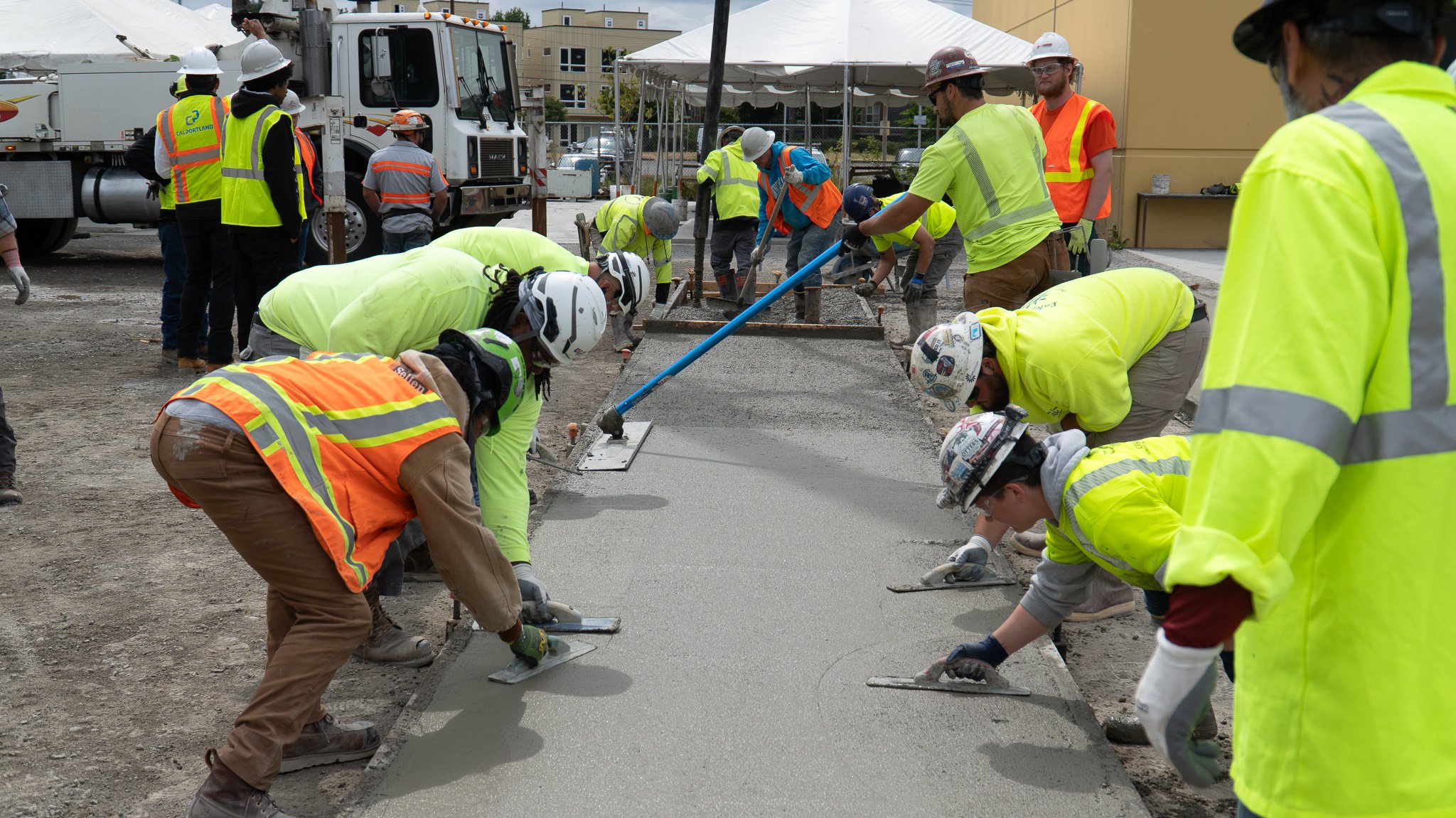
2025 placer day events the apprentices are actively finishing low carbon concrete mix design.
One theme that came up clearly across all three conversations: when policy is written and specifications are set, the workers who actually place the concrete are consistently the last ones consulted, if they're consulted at all.
Local 528's growing engagement with Climate Jobs Washington has helped change that dynamic, getting them into industry conversations and in front of decision-makers where their knowledge and experience can actually influence outcomes.
Dumas reflected on that journey:
"Once we started to get more involved and lean into the conversation, we recognized how far behind we were. Climate Jobs helped catapult our name into the conversation, to really be effective and show up in these spaces."
The Outlook: Ready to Work
Concrete is the most widely used building material on the planet and the need for it is only growing.
The US alone spends an estimated $15 billion a year just maintaining existing infrastructure. Add in the surge in new construction driven by tech campuses, energy projects, and housing demand, and the job opportunities for trained, skilled concrete masons are substantial.
Local 528 is betting that being ahead of the curve on green materials and new technology isn't just the right thing to do for the planet. It's the smart play for their members' long-term job security. When the broader market shifts to low-carbon mixes and the job sites start using 3D printers, their members will already know what they're doing.
OPCMIA Local 528 represents cement masons and concrete finishers in the Pacific Northwest and Alaska. To learn more about their apprenticeship program and 3D printing work, search Local 528 on YouTube.
Climate Jobs Washington advocates for working families and union labor in Washington State's transition to a clean energy economy.
